日本語
日本語

As electronics continue to shrink while power demands grow, thermal management has become one of the most critical challenges in PCB design. Standard FR-4 boards often struggle to dissipate heat efficiently, leading engineers to turn to a more capable alternative: the aluminum PCB. Known for its exceptional thermal conductivity, mechanical durability, and cost-effectiveness, the aluminum PCB board has become the go-to solution for LED lighting, power electronics, automotive systems, and beyond. This guide covers everything you need to know about aluminum core PCB technology—from how it works to when you should use it.
What Is an Aluminum PCB?
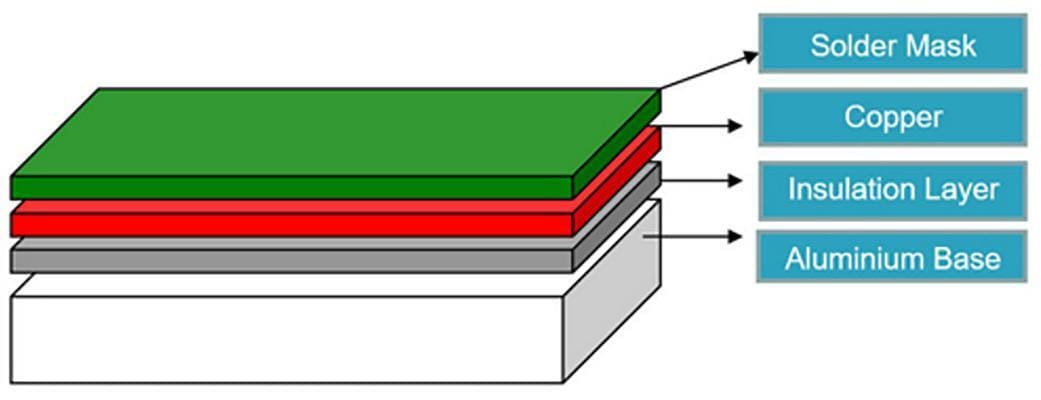
An aluminum PCB—also called a metal core PCB (MCPCB) or aluminum core PCB—is a type of printed circuit board that uses an aluminum substrate as its base material instead of the traditional fiberglass (FR-4). The board typically consists of three primary layers:
Circuit Layer: A copper foil layer (typically 1 oz to 4 oz) that carries the electrical signals and connects components.
Dielectric Layer: A thermally conductive but electrically insulating layer that bonds the copper circuit to the aluminum base while allowing efficient heat transfer.
Aluminum Base Layer: The metal substrate that provides structural support and acts as the primary heat spreader, drawing heat away from components and distributing it across the board.
The thermal conductivity of aluminum PCBs typically ranges from 1 W/m·K to 3 W/m·K for standard versions, and up to 8 W/m·K or higher for high-performance variants. Compare that with FR-4's thermal conductivity of roughly 0.3 W/m·K, and the advantage becomes immediately clear.
Key Advantages of Aluminum Core PCB Technology
Choosing an aluminum core PCB over a conventional board delivers several meaningful engineering benefits:
Superior Heat Dissipation: Aluminum conducts and spreads heat far more effectively than fiberglass. This keeps component junction temperatures lower, directly improving reliability and extending product life.
Mechanical Strength: The aluminum base provides a rigid, dimensionally stable platform that resists warping under thermal cycling—important for assemblies that repeatedly heat and cool.
Lightweight: Despite being metal, aluminum is significantly lighter than copper or steel alternatives, making it attractive for weight-sensitive applications like automotive electronics.
Environmentally Friendly: Aluminum is non-toxic and highly recyclable, aligning with RoHS directives and broader sustainability goals in electronics manufacturing.
Cost Efficiency: Compared to copper-base MCPCBs, aluminum offers a strong price-to-performance ratio, making it accessible for high-volume production runs.
Round Aluminum PCB LED Applications: A Growing Market
One of the most widespread uses of aluminum PCB technology is in LED lighting. The round aluminum PCB LED format—commonly seen in downlights, spotlights, street lamps, and grow lights—is specifically engineered to support high-power LED packages. These circular boards mount directly behind LED arrays, pulling heat away from the diodes before it can cause lumen depreciation or premature failure.
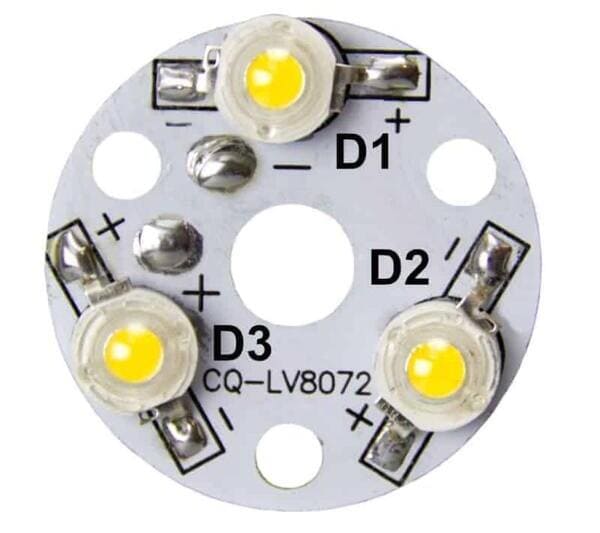
Why round? LED modules are often designed around a circular die pattern that matches a round substrate, maximizing copper coverage directly beneath each emitter. Standard diameters range from 20 mm for compact spot modules to over 100 mm for high-bay industrial fixtures. The round aluminum PCB LED format also simplifies heatsink integration, as circular boards mate cleanly with cylindrical heatsink profiles common in commercial lighting.
For LED manufacturers, the aluminum PCB board isn't just a thermal solution—it's the foundation for reliable, long-life luminaires. A properly designed aluminum core PCB in an LED fixture can help maintain junction temperatures below the threshold at which lumen output begins to degrade, often cited as 85°C for most commercial LEDs.
Common Applications Beyond LED Lighting
While LED lighting is the most visible application, aluminum PCBs appear across a wide range of industries:
Power Supplies and Converters: Switching power supplies, motor drives, and DC-DC converters benefit from aluminum substrates that handle the heat generated by MOSFETs and rectifier diodes.
Automotive Electronics: Engine control units, LED headlights, and EV battery management systems increasingly rely on aluminum PCBs to survive under-hood temperatures and vibration.
Audio Amplifiers: High-fidelity amplifier stages that push significant current through output transistors use aluminum substrates to keep the signal path clean and the devices cool.
Industrial Motor Controllers: Variable frequency drives and servo amplifiers dissipate substantial heat; aluminum PCBs reduce reliance on bulky external heatsinks.
Design Considerations for Aluminum PCBs
Designing for an aluminum core PCB requires adapting some standard PCB practices. Because the aluminum base is conductive, the dielectric layer must be carefully specified to ensure reliable electrical isolation—any breach in the dielectric can result in a short to ground through the aluminum. Always confirm the dielectric breakdown voltage in your design specification and select materials accordingly.
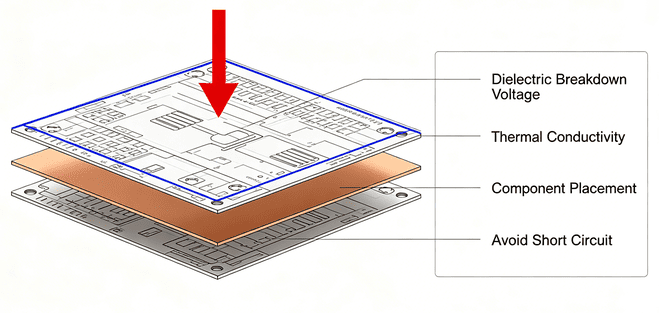
Thermal vias, which are commonly used in FR-4 boards to conduct heat between layers, behave differently in single-layer aluminum PCBs. Because the aluminum base itself is the heat spreader, the design priority shifts to minimizing the thermal resistance of the dielectric layer. Thinner dielectric layers improve thermal conductivity but reduce electrical isolation headroom—finding the right balance is central to any aluminum PCB design.
Component placement matters too. Thermally dominant components should be centered over the aluminum substrate where possible, avoiding edges where heat spreading is less effective. Avoid placing temperature-sensitive passive components directly adjacent to high-power devices without adequate copper pour separation.
Aluminum PCB vs. Other Metal Core Options
Aluminum isn't the only metal substrate available, but it's the most widely adopted. The table below compares the three main metal core options across the criteria that matter most for practical design decisions.
| Property | Aluminum | Copper | Steel | FR-4 (Reference) |
|---|---|---|---|---|
| Thermal Conductivity | 1–8 W/m·K | ~400 W/m·K | ~50 W/m·K | ~0.3 W/m·K |
| Weight | Light | Heavy | Medium | Light |
| Relative Cost | Low–Medium | High | Low | Lowest |
| Mechanical Strength | Good | Excellent | Excellent | Moderate |
| Machinability | Excellent | Good | Moderate | Good |
| Typical Applications | LED, power electronics, automotive | High-power RF, aerospace | Rare; niche magnetic uses | General electronics |
For the vast majority of thermal management applications, aluminum strikes the best balance. Copper delivers superior conductivity but at a cost and weight premium that is rarely justified outside aerospace or high-power RF designs. Steel offers little thermal advantage over aluminum and is largely absent from mainstream PCB manufacturing. Aluminum core PCB technology remains the dominant choice when the goal is reliable heat dissipation at a practical cost.
Choosing a Manufacturer for Aluminum PCBs
The performance of a well-designed aluminum PCB depends largely on the manufacturing process. Thermal conductivity, dielectric bonding strength, and copper adhesion are all critical factors in ensuring long-term reliability and stable operation.
As a trusted PCB manufacturer with decades of experience, PCBgogo places great emphasis on every key stage of metal core PCB production. From material selection and lamination to final inspection, we maintain strict quality control throughout the entire manufacturing process.
Whether you are developing LED lighting systems, power electronics, or industrial control equipment, our team can help you choose the aluminum PCB solution that best fits your project requirements. Request a quote today and move your project from design to production with greater confidence and efficiency.
Conclusion
The aluminum PCB has earned its place as a foundational technology in modern power and lighting electronics. From the round aluminum PCB LED modules illuminating commercial spaces to the aluminum core PCBs managing heat in automotive control systems, this board type solves a problem that conventional FR-4 simply cannot: keeping high-power electronics cool enough to run reliably for years.
Whether you are designing a new LED driver, a high-current power converter, or an automotive control module, specifying an aluminum PCB board is often the engineering decision that separates a product that lasts from one that fails prematurely. Work with experienced manufacturers, define your thermal requirements clearly, and select the right dielectric for your application—your design will perform better for it. If you're ready to move from design to production, reaching out to a specialist like PCBgogo for a quote is a practical next step to validate your aluminum PCB specifications and get accurate lead time and pricing for your project.
Frequently Asked Questions
Can aluminum PCBs be multilayer?
Most aluminum PCBs are single-layer or double-layer. True multilayer aluminum PCBs are technically possible but rarely manufactured, as the bonding process between multiple copper layers and aluminum is complex and expensive. For high-density designs that also require thermal management, hybrid stackups combining FR-4 layers bonded to an aluminum heat spreader are a more practical approach.
What is the maximum operating temperature for an aluminum PCB?
This depends primarily on the dielectric layer material. Most standard aluminum PCB dielectrics are rated to 130°C–150°C continuous operating temperature. High-temperature variants using polyimide-based dielectrics can handle sustained temperatures above 200°C, making them suitable for automotive or industrial environments.
Is soldering on aluminum PCBs different from FR-4?
The copper circuit layer on an aluminum PCB solders the same way as any other copper-clad board. However, the aluminum base conducts heat rapidly, which can affect reflow profiles—particularly for hand soldering near the board edge where the aluminum acts as a heat sink. Standard SMT reflow processes generally work well with appropriate preheat profiles.